This is the full entry for week
19
Remember the picture of the cow I put up last week? She was living
with a goat under the stairs in the appartment building where I was staying for a
holiday in Dhaka this week. Why? For the Muslim festival Eid al-Adha, which lasted
pretty much all week with the high point on Monday when each family sacrifices a cow /
goat, hence the livestock under the stairs. As a result it's known as Eid of Sacrifice
or Bloody Eid amongst VSO volunteers for reasons I'm about to explain.
The festival commemorates Abraham's willingness to sacrifice his 2nd
son Isaac who was, according to the Bible, born when Abraham was 100 years old. Abraham,
progenitor of the Hebrews, probably lived in the period between 2000 and 1500 BC and is
regarded by Muslims, who call him Ibrahim, as an ancestor of the Arabs through his 1st
son Ishmael. God demanded that Abraham sacrifice Isaac as a test of faith, but because
of Abraham's unquestioning compliance God permitted him to spare Isaac and rewarded
Abraham with a formal renewal of his promise that he would make him a "great
nation" and promised Abraham a son by his wife Sarai (Sarah). Christians, Muslims
and Jews accept Abraham as an epitome of the man of unswerving faith, a view reflected
in the New Testament.
That's the historical and religious background of the event, but what
actually happens? Well, and without putting too fine a point on it, cows and goats are
basically slaughtered in the street by having their throats cut and are then chopped up
until all that remains are the hide and the lower jaw (both are collected later). We
knew this was coming, but when I got up on Monday morning and asked the others how
things looked outside they weren't very talkative and just said I should have a look
for myself. What I saw was 4-5 groups of men cutting up dead cows with large puddles of
blood all over the road. It wasn't pretty, and while I do have photos I didn't think it
best to publish them on this page. I didn't actually see any of the killing, though at
one point I saw someone leading a live cow down the street between open carcasses of
ex-cows and found it rather extreme.
When I talked about Eid with Rabi at BRIF I found that I had quite
negative views about it. Obviously there's the question of hygiene as preparing meat in
any major city street is not ideal. Next was the sight of large quantities of blood
lying in the road which I found disturbing. Finally was the act of killing itself,
which is not something we're used to seeing in our culture. He then told me about other
aspects of the festival. For example, it is customary to exchange one-third of the meat
sacrificed during Eid al-Adha as gifts; another third is donated to the poor, and the
remainder is kept. From our balcony we did indeed see poor people going from door to
door receiving meat. I should also mention that Habib's Mum gave me a large bag full of
beef that is now sitting in my fridge while I think of something to do with it...
Secondly, the sacrifice of the cow or goat is seen as a cleansing moment as your bad
thoughts and frustrations are said to flow from you as the blood flows from the beast.
Rabi himself admitted that he felt liberated of the small amount of anger he was holding
from not having spoken to his girlfriend on the phone the night before.
We often assume that these sorts of traditions are extremely ancient
but I've read that for Bangladesh sacrificing cows is quite a recent development
(1940's onwards). Formerly being part of India put modern-day Bangladeshi muslims in a
minority amongst Indian hindus who obviously regard the cow as something that deserves
slightly better treatment than having it's throat slit in the street. As a result the
muslims had to make do with goats, which explains why there were a fair few of them
about as well. The book that I learnt this from also denounced the way the festival had
lost sight of its original goal of sacrificing something of value to become a
competition to buy the most expensive cow in the neighbourhood. This anti-materialistic
slant on things sounds a lot like how some people view Christmas these days don't you
think?
Apart from these bloody events my week in Dhaka went very well indeed.
The goal was rest and relaxation with booze and westen food and I achieved it
effortlessly. I've noticed that the general lack of dairy products in my diet (cheese
and yoghurt are not easy to come by round these parts) along with less meat has made me
slimmer. Since I've been back however I've found, much to my satisfaction, that the
notch I'd gained on my belt has been well and truly lost. Another victory for western
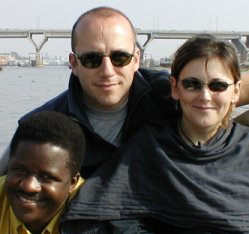
ways hurrah! Another high point of the week was a trip on the river in Dhaka (hence the
photo). I'd love to tell you about the beauty of the banks, or the wildlife we saw, but
I'd be telling you porkies. It was however interesting to see Bangladesh river life in a
country that is, let's face it, just full of rivers and flood zones. The river also
turned out to be the quietest place in town we've found so far, and that was a find in
itself let me tell you!