This is the full entry for week
21
It is fair to say that before coming to Bangladesh I'd never given
women's rights any real thought. I mean, back in France or the UK, if a chap wanted to
wind up a female friend he'd make some comment about her rightful place being the
kitchen. A similar comment to a Western woman out here might well necessitate
considerably more medical attention with a subsequent inability to ensure the survival
of the family name.
So what are we really talking about? In the UK women earn on average
around 60-65% of what men do, and in Ireland it's apparently nearer 40%. As shocking as
those figures are they are nothing compared to what I hear about a woman's lot around
these parts. Let me put is this way: Domestic violence is apparently the norm with wife
beating a national sport, especially in the country. I don't have exact figures but many
many women are murdered by their husbands. An interesting local speciality is throwing
acid into a woman's face to basically ruin her life, often after disputes about dowries.
Nice huh? This doesn't really compare to our problems of equal pay but these are all
issues on the same scale but at different ends I suppose.
If I'm writing about this it's for 2 reasons really. The first is not
specific to this week but a general raising of awareness thanks to female VSO volunteers
and how their experience of life here differs to mine. The most noticable difference
relates to how we dress, and to a certain extent this is related to the muslim culture.
According to Islamic law a man must be covered from the waist to the knees while a woman
should only expose her face and hands. If that wasn't strict enough by Western standards
there is also something about not being able to distinguish a woman's shape i.e. her
curves. From what I can make out there is an underlying assumption that the female form
is just too exciting for men to bear, and so must be covered and disguised to protect
all concerned. Apart from painting a rather sad picture of a man's ability to control
himself when faced with a member of the fairer sex, the whole thing strikes me as
actually being counter-productive. Surely forcing women to cover themselves in shapeless
garments will only heighten a man's interest in what lies underneath, not to mention
putting the blame on women for a man's inability to cope? At the other end of the scale
I understand we have Newcastle-upon-Tyne where women certainly don't feel any social
pressure to cover themselves (nor the cold one presumes...) which in some cases is
regretable given the dimensions of some the specimens on display. I digress.
"Big deal - women have to dress differently" I hear the
lads cry. Well, this change goes to the heart of the problem as it removes a woman's
feeling of femininity, of what makes her different from men. On top of this women are
generally excluded from social and political life despite statements to the contrary in
the Bangladesh constitution. To add insult to injury the 2 main and opposing political
figures in this land are women! When you go into town during the day or night you will
not see many women out at all, particularly outside the capital. At first you don't
notice this as there's so much else to take in, but then you slowly start to feel that
something's not quite right. This distancing of women from social situations is a
remarkably effective tactic in keeping them, dare I say, "at bay", as they
can't mix with or make friends and hear news about what's going on locally and elsewhere.
Anyway, enough of this negativity - I think you get the picture. I certainly am
beginning to see things in a different light and how it affects my volunteer friends
daily and in very profound ways.
Soooo, what's being done about all this then? Well, funny you should
ask as only this week I went to visit a project run by another NGO where a couple of VSO
volunteers are working. It's goal is to empower women by forming groups within a
federation. Basically, a local community forms a group to discuss and address social
issues. This group elects a representative who then sits on a village committee with
other group reps. But it doesn't stop there as these village groups also each elect
someone to stand at the next level up (Union) and these groups in turn elect 1 person to
stand at the highest level which is the central committee. This last level roughly
corresponds to where local government begins. All the project is attempting to do is get
people to come together and structure their approach to be better at lobbying local
government bodies and other service providers for solutions to their daily problems.
From what I saw it's been very successful though those results can't
happen overnight. There are now 3 women from the project's groups sitting as elected
members of 2 different local government bodies. More important than that though is the
change in attitude and confidence of the women involved. As someone from the NGO put it,
in the beginning they were quite shy and didn't say much, now you can't shut them up!
What I find intersting is that the rise in these women's status has made men respect
them more causing a drop in domestic violence. These women say that they now play an
active role in managing the family which wasn't the case before. In particular, the
oppression they often felt from mothers in law has lessened (wives traditionally join
the husband's household and family which can create considerable tension with the mother).
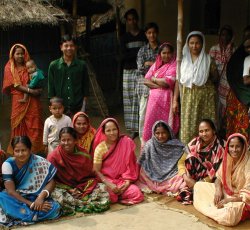
At the end of my visit I was asked by the women's group if I was
married. Next up they asked if I'd like a Bangladeshi wife. Errr no, and you can judge
for yourselves from the photo.