This is the full entry for week 29
I celebrated Bangla New Year this week. In the run up to the year
2000 I remember learning that certain parts of the world used wholly different calendars,
or none at all, and so had either already celebrated the coming of the new millenium or
were a few centuries away from doing so. I also remember finding the idea of not having
a calendar quite freaky, that somehow the need to define the chronological order of
things was a basic human need. Wrong again! In Bangladesh they have changed to using the
same calendar as in Europe (the Gregorian calendar named after pope Gregory XIII who
decreed the changes to the previous Julian calendar in 325 AD) but still celebrate the
old Bangla New Year anyway. Interestingly, the UK adopted the calendar in 1752 and lost
11 days between September 2nd and September 14th to do so. Well I thought it was
interesting, but then I don't get out much these days.
Anyway, I thought a bit of history about the calendar would make a
nice change this week, and I'd also recommend looking into the history of calendars as
it's bordering on interesting in certain places. For example, did you know that all
calendar reform ideas have failed, including the so-called World Calendar that was
considered, but not adopted, in the United Nations in 1954? This calendar is based on a
52-week, 364-day year starting on Sunday, January 1, with the 365th day, called Year-End
Day, intercalated, or added, without date or day of the week.
Getting back to the subject at hand, on April 14th in Bangladesh, and
the 15th in West Bengal in India, we entered the year 1411. The difference may be due to
certain calendar changes made during General Ershad's military and pseudo-civilian rule
in Bangladesh (1981-1990). The calendar itself was introduced by a Muslim Mongol
conqueror of India, Emperor Akbar, descendant of Babar, Tamerlane and Ghenghis Khan
would you believe.
The Bengali Calendar in use today was created on March 10 or 11th
1584/5 AD. It amalgamated the old Indian calendar and the Hijri (Arabic) calendar and
was originally called Tarikh-e-Elahi. That was not, however, year zero as Akbar had
ascended the throne in the year 1556 AD the new calendar was backdated to that year
(963 in the lunar Hijri era or Islamic calendar). Hence the new Bangla calendar began at
1556 AD with zero coinciding with the zero of the Hijri calendar. The Bangla calendar
was made a solar calendar to better coincide with harvest times and facilitate better
collection of taxes (once again the tax man rears his ugly head...). This caused the
difference between the Islamic Hijri year and the Bangla year as the Hijri lunar
calendar is 11/12 days shorter than the solar year and so has raced ahead. Incidently,
the Islamic calendar is calculated starting from 622 AD, the day after the Hegira, or
emigration of Muhammad from Mecca to Medina, and consists of 12 lunar months.
The number of days in the Bengali months comes from an ancient solar
treatise, the Surya Siddhanta, which uses the zodiac. The days per month depend on the
Sun's stay in a particular zodiac and so the number ranges from 29 to 32. The sun enters
the Mesh Rashi (Aires) on 15th April and this is the first day of the Bengali month
Baishakh (Boishakh) and also the first day of the year according tthe new calendar. In
the recent past the number of days was fixed to 30 and 31... and so dates changed.
Originally in the region, the first of Chaitra was the beginning of the new year but a
new date was selected by Akbar and his administration. It was a date selected from both
the Arabic and the Bengali calendars. In 963 AH (Hijri) the first arabic month, Muhurram,
had coincided with Baishakh (Boishakh). So the first of Boishakh (Pahela Boishakh) was
selected as the first day of the year replacing Chaitra first. Even though the names of
the original months lived on, the date for the new year was changed.
What then do our Bengali friends do to celebrate New Year? Do they
drink lots of sweet milky tea and congregate around a significant monument or square
waiting for the town watchman to ring out midnight?! Err, no. Instead, and based on what
I saw locally, they hold a sort of fair where a variety of events are organised. There
are of course the obligatory stalls selling trinkets and female beauty products (notice
the contradiction with society's negative attitudes towards women?) as well as food and
tea. More important though are the games. In the morning and early afternoon it's
essentially for the children, with my personal favourite being a game for the boys where
you have to knock over the others until no one is left standing... while hopping. I seem
to remember playing a similar game for rugby training, and there was always a fine line
between blundering into someone with all your might and being a little bit more cagey
just in case the other person stepped aside at the last minute as you sailed past and
fell on your arse. Good game though.
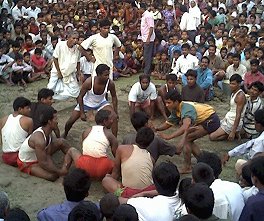
The highlight of the day, the event that really drew the crowds in,
was a game of what my boss swears is called Hoodoodoo (phonetic spelling obviously). I
actually thought it was called something different so if you recognise the game and know
it's name please tell. Anyway, it's the Bengali game also played in India where you have
2 teams on a smallish rectangular pitch, each one in its own end or half. In turn, each
team sends out a player who attempts to touch an opposing player and get safely back to
his half hence scoring a poit. If the defending team succeed in tackling him (once he's
entered their half) and prevent him from getting home then they score either 3 or 5
points. I watched the game for a while, even asked around me, but am still utterly
clueless as to why sometimes the umpires awarded 3 points, sometimes 5. The umpires
incidently were 2 oldish guys with wispy beards who only communicated by blowing their
whistles. At times it sounded like Ivor the engine was having an argument with a really
excited raver.
While I've seen clips of the game shown on TV in the UK, I hadn't
appreciated just how physical even violent it was. Some of these guys were pretty
powerfully built, and the tackling would have made Serge Betsen look on with a proud yet
understated gallic smile snaking across his face. And therein apparently lies the
downfall of what is Bangladesh's national sport. It would seem that less and less people
are playing it because it's too tough. Meanwhile of course, football and cricket grow in
popularity, and the latter is an explosion waiting to happen as they play it everywhere.
I don't just mean on playing fields either as I've seen kids and adults playing cricket
in paddy fields as well as in the middle of a busy street in downtown Dhaka. Madness.
Anyway, I had a pretty good day and now have a bizarre Hindu festival to look forward to
this week. I'm told it involves a man drugged up to the eyeballs, a large fish hook and
a bamboo crane...