This is the full entry for week
32
While I actually spent this week in Dhaka too (3 public holidays in 4
days - too good to miss) now is actually a good time to talk about what's happening at
work. It's fair to say that I've not told you guys much about what I'm up to and how
things are progressing, so an update on that front is probably long overdue. I've also
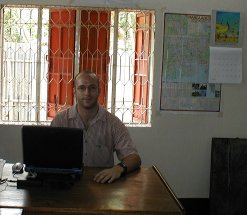
chosen to move offices to share a big one with other project staff (see photo). Anyway,
basically, my work with BRIF can currently be put into 3 main categories i.e. assessing
and improving the organisation as a whole, designing and implementing a new strategic
review process, and revamping the current web site.
Taking each one in turn, I've been working on the organisational
assessment ever since I arrived in December. It's basically a review of how the
organisation works, both what it's doing well and not so well, and will be used as the
platform on which the various changes BRIF decides to do will be built. The internal
review with management and staff was finished by mid-January, but I also wanted to get
input from external partners i.e. donors about how BRIF has performed in the past and
where they see the relationship going in the future. In the end I interviewed 3 different
international donors and they were extremely honest and critical in their feedback,
probably because I'm an outsider and not strictly speaking a member of Habib's staff.
Being European was also an advantage I suspect, but either way I got some great
information about BRIF past, present and hopefully future if we get our act together!
Those interviews took me to roughly the end of March, and while I'd
been documenting and analysing as I went along, I had to totally review and restructure
my report to make it as clear and simple as possible. I've found that getting reasonably
complicated ideas and conclusions across to non-native English speakers is a great
challenge, not only when speaking but especially when writing documents. Previously you
could almost say that I didn't go that extra mile to simplify and clarify the overall
message as well as each individual point. I'm not sure I've got the hang of it yet but
hopefully when I do it'll stand me in good stead for whatever I do next! Anyway, I
finished the report over a month ago but it took me a few weeks to pin Habib down for
long enough to present it to him. In the end we spent 3 hours one evening going through
it all, including an interruption from a delegation of 3 local men seeking to sell Habib
some land, one of whom annoyed the hell out of me by picking up and rearranging my
documents. That was longer than I'd anticipated, though we did go over everything quite
thoroughly and it was good practice to see how easily (or not as it turned out) it would
be to share the conclusions of the report.
As of today I'm waiting for Habib's final feedback on the report, and
this should have happened last night but he was ill. Once he's signed off on it I can
then organise a workshop with most of the staff to share with them what the state of
play is before, and this is the critical bit, asking them to prioritise things and so
define a shortlist of issues to concentrate on over the next few months at least. This
is key as it's extremely important that everyone a) understands where we are i.e. what's
wrong and why, before b) agreeing to and supporting the changes that will fix the
problems. Where this all gets tricky is that the issues the organisation decides to
concentrate on should also be the most important ones overall rather than the ones that
interest the majority of staff. To give an example, BRIF pays its staff and bills using
the cash it receives from donors. In other words, it only has enough finances to pay for
whatever the project budget says it should be spending it on and nothing more. It is
hence extremely important that BRIF be good at cash management to ensure that money is
available when required (the nearest bank is 20 minutes away on a motorbike) and not
"lose" any along the way. If I asked the staff to vote on what they consider
to be most important they'd probably talk about more training or motorbikes, but not
cash management systems. Get the picture?
The second pot I've got simmering away on the stove without any
immediate danger of boiling over is a strategic review. Now I have to admit that my
practical experience of strategic planning is tantamount to zero. Sure, I know the
theory and can recognise a weak strategy paper when I see one, but I've never actually
designed and/or facilitated a strategic review process. This was something that was
mentioned in the placement description documents VSO sent me last summer, and I was
quite looking forward to doing some strategy work, but as I found out more everyone
seemed to be saying that my predecessor had already done the work and there was nothing
left to do. Obviously I was a little disappointed about that, so imagine my reaction
when it became clear that they hadn't done all of the work at all! In actual fact, the
more I found out the more it became clear that a strategic review was required to define
and share the organisation's guiding principles and values i.e. its vision and mission.
In the past I've been quite sceptical of these sorts of exercises,
not to mention the documents they produce, as I never really saw the value in having a
mission statement stuck up on notice boards in every office. That was until I started
working for an organisation that is genuinely trying to achieve something other than
higher revenues and profits. All of a sudden it seemed obvious to me that staff and
management alike needed clear statements about what they were trying to achieve as well
as the values they should represent and promote internally and externally. In the case
of BRIF those statements exist but only on marketing documents it sends to potential
partners and volunteers. In other words, senior management has begun to realise how
useful such things are when explaining the organisation's raison d'etre to the outside
world, but isn't quite there yet when it comes to helping staff all work towards the
same goals. Once you've got the main goals and principles defined and internalised you
can then use them to make decisions about what areas you want to work in and how, and
ultimately you should be able to relate every activity of every person back to the
organisation's overall mission. That at least is the ultimate goal, and that's where an
interesting question arises about how far a strategic review should go.
Not being an expert in the matter I've asked other volunteers about
strategic planning and read documents produced by other NGO's here in Bangladesh. What I
hadn't appreciated initially, and which will sound bloody obvious when I say it, is that
you need some experience of strategic planning to do it properly. What that means is
that each strategic review should be better and deeper than the last, which begs the
question "where do you start then?". I've not yet come to a firm conclusion,
and Habib and I haven't discussed it at all, but right now I think I'd be happy if by
the end of my time here BRIF worked with and refered back to a clear mission statement
as well as a set of principles that guided staff decisions and behavior. If they then
decided to go a bit further and start clarifying working areas and strategic aims and
objectives then even better! That may not sound terribly ambitious but I'm very wary of
pushing them through a complicated process that will result in an extremely intelligent
document that no one will ever understand let alone use. And that's not even refering to
any skills transfer that's supposed to happen along the way, if I'm lucky! Yep, keep it
simple I reckon.
The final thing is the web site, and for those of you who've visited
it you may well agree that it could be better. There's nothing horribly wrong with it,
and if the number of e-mails Habib gets from around the world asking to come and work
here is anything to go by it's actually quite successful. That said, it's not the
clearest and best structured site I've ever seen, and the general look and feel seems to
clash a little too. Soooo, when I mentioned to Habib in passing that I knew something
about web sites his eyes lit up and asked me to redo BRIF's. That was in December, and I
basically dragged my feet about it for several months as I wanted to be sure we were
progressing on the real issues. It was however perfectly clear that Habib was very keen
to improve it, so I began to see it as a carrot I could wave in front of him while we
did other organisational things too! Finally, about 3-4 weeks ago I got stuck in and
have produced some pages and a new structure that now needs some up to date information
about projects etc. as well as some happy smiley photos. Hopefully, if Habib isn't too
ill, we'll do some of that this coming week so if you haven't been to www.brif.org go
and have a look before the new site hits the web.
At the risk of sounding all geeky, I got quite a kick out of doing
this new site. While I'd picked up some pointers from my Dad about HTML etc. for my web
site, I'd never designed and coded a site from scratch. The first few days I really
struggled, but with a bit of perserverance and the realisation that there was no one to
help me I eventually cracked it. It's really that last point that counts for me, and
it's been one of the most important things I've learnt professionally these last months.
In the past I've worked for large organisations in teams so could ask for advice or tips
if I wasn't quite sure about something. I don't have that luxury here, and I'm
effectively my own boss in so far as I can achieve as much or as little as I want.
Seeing as I want to look back on my time here and clearly see some postive changes I've
helped to bring about I have to push myself to do things more than I've ever done in the
past. Back in Paris, if I said I was working at home that meant I'd do a few hours max
as I just couldn't motivate myself without an office environment and colleagues around
me. I also found that even daytime TV was quite appealing compared to work once I'd done
all my e-mails! Now there's a development question for you - will Bangladesh ever have
the equivalent of Richard and Judy?!