This is the full entry for week
35
It's been a good week, with lots of good work and some critical
events in the life of my placement. The most important for me I'll save to last as I
want to talk about THE workshop I ran on Saturday morning first.
One major difference between my work here and my previous
professional experiences is the need to design and run workshops to get the job done. We
use the term "workshop" to cover virtually any gathering of people here, so
let me narrow it down a bit and explain why they seem to be such a major part of
development work. Basically, and in my humble opinion, development is all about change
and nothing but change. As a result, and even if the changes being proposed and
implemented are beneficial to almost everyone, some people will find it all a bit scary
and resist as change of any kind is generally an uncomfortable experience. Sometimes
however, the change will tread on the toes of influencial or powerful people who can
make or break the project. As a result, it is essential to involve the people affected
by the change, directly or indirectly, as early as possible so they can shape and
"own" the change hence reducing resistance and increasing the likelihood of
the change lasting.
What I've just described is applicable to any situation involving
change anywhere in the world, whether you're implementing a new accounts software
package in Norway or advocating the use of condoms to fight the spread of HIV in China.
What makes development work slightly different in my experience, especially as a
foreigner, is that it is very easy to adopt an "all conquering hero" approach
as one ex-VSO volunteer called it and force change on a group of people because you
apparently know what's best for them and they're not educated enough to do it
themselves. While it may seem you're getting the job done faster I'd suggest there are
at least 3 very good reasons for not working this way:
1) Chances are you do indeed have some very good ideas, but chances
are as well that you haven't fully grasped all that is going on and how the people
involved feel because you are not one of them. Short of living with the future project
beneficiaries as one of them for a reasonable length of time there is only so much you
can really understand about these people's lives and how their community works.
Involving them reduces the risk of getting it horribly wrong.
2) Again as a foreigner, and especially if you're white, people will
generally avoid giving constructive feedback or open criticism about your ideas as they
don't want to cause offence. Instead, they'll just drag their feet during implementation
or not bother supporting the project once you've gone. Either way, things won't have
improved in a sustainable way and the change will not take root.
3) As mentioned above, for the change to truly be successful the
local community etc. must take it over and integrate it fully. This could involve
anything from skills training to influencing cultural values, but the bottom line is
that things must continue for the better after the project has finished and you've
packed up your bags and ridden off into the sunset.
Soooo, seeing as VSO volunteers all generally work to bring about
positive change, we need to work closely with the people involved on a daily basis.
Sometimes though, when we need to discuss issues with a group, we will organise a
structured yet open meeting to help people share their views and come to a collective
decision. These are workshops as I understand them, and they are generally very
successful in Bangladesh as the people have a strong sense of community and
participation. Why then have I not really had much workshop experience before then?
Well, I've certainly facilitated workshops, but I'd never designed them before
and they're damn tricky I can tell you! They're a subtle mixture of keeping enough
structure to reach the stated objectives while leaving participants enough freedom to
express themselves fully and take the direction they want to. You also need to include
different types of activities to keep participants interested, but not throw in
exercises for the sake of it. All in all I find it really interesting work, and it's
surprising how universal these things are i.e. what makes a good workshop in the UK
would probably work well here and vice versa as it's all really about a bunch of people
in a room working together.
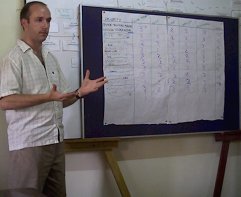
What then of my workshop on Saturday? Well, I've finished my
assessment of the organisation, and I've even got Habib's approval of what it says. Next
then, I needed to share it with the rest of the organisation, starting with management
and key external partners, to keep everyone on the same page and ensure we haven't
missed anything important over the last few months that needs to be included in the
report. Having got that common understanding and confirmation, the organisation needed
to collectively decide what it wanted to do about it. I of course could have told them
what I thought the top 5 issues were, but for these changes to work they must be done by
BRIF management and staff rather than the token white boy.
And so it was, using a variety of props and sessions that I won't
bore you with, that we came up with a tight list of 10 priority items. We did actually
assess them individually but in the end the difference between them was so slight
that it wasn't worth ranking them. Interestingly enough the 2 pre-workshop favourites
(recruiting a 2nd in command and writing a strategic plan) didn't fare too well as the
former didn't come out top (though there is no doubt in anyone's mind that it's the
number 1 problem) and the second didn't even make the cut into the last 10! In true
Bangladeshi style we awarded a bonus point somewhere and decided the strategic plan
needed to be done anyway so all was not lost! All in all I think we got a good result,
and the participants seemed to follow the proceedings quite well though I underestimated
how much they'd struggle with the concept to using criteria to prioritise a list of
different issues. I should have used a simple example to get the point across - you live
and learn eh?
So where does this leave me now? Well, collectively we decided that
the project coordinators should inform their staff of what the workshop was about and
its conclusions rather than holding another workshop for them (phew!). The next step is
a meeting with all the guys who are now the proud owner of a project or 2 to address the
priority issues. I sensed some apprehension and the fear of the unknown when we asked
people to take responsibility for these things, so while the issues themselves aren't
too tricky, getting the projects up and running to address them might well be. But
that's how Bangladesh works really, as it doesn't get easier as you go along, it just
gets more challenging!
As important as this workshop is for the future success of my time
here, something else happened on Tuesday that I consider to be a turning point in my
placement. As I think I've mentioned before, there has been a question mark hanging over
when CARE will stop paying 2/3's of my salary and basically enabling BRIF to have my
services. On Tuesday the 3 VSO volunteers concerned by the CARE-VSO initiative along
with VSO's acting Country Director met with CARE in Dinajpur as part of the normal
quarterly review process. After a lengthy discussion about CARE funding in general it
was finally clearly stated that our placements will not receive any funding beyond March
31st 2005, a full 8 months before my 2 year placement is officially set to end.
In all honesty I had been anticipating this response as all the other
echoes I'd had from within CARE pointed in the same direction. That said, there was also
a feeling that money could be found elsewhere within CARE to support the remainder of my
time if I made the right approaches to the right people. And so it was that I came to a
decision point about my future here. When I look at my situation from a professional
point of view it seems clear that I don't need the full 2 years to achieve my
objectives. I even believe that it would be better to set an earlier deadline to
generate a sense of urgency about my work rather than running the risk of things sliding
as there'll always be time to do it later. Personally, I also need to keep busy and
don't see how I could keep myself occupied for 2 full years without going beyond an
adviser's role and actually starting operational work that couldn't be maintained by
others. Secondly, I believe there's a limit to how much change an organisation can
incorporate at one time before a period to consolidate and breath is required, and 2
years for BRIF would be too much.
On a purely personal level, and this is much more important than the
professional aspects, I'm also not convinced I want to live like this for 2 whole years!
To be perfectly honest, I'm getting a tad pissed off with finding my kitchen flooded
every time it rains (down the poorly designed chimney) not to mention the small turds
that magically appear overnight (I've now seen a dung beetle in action whilst eating
breakfast) and the evidence of some animal attempting (and sometimes succeeding) to
steal my food. As beneficial as this experience is to me, there's no point in being
masochistic and depriving myself of so many people and things I love when I can
accomplish what I came to do in less time. Whereas before the idea of living in the UK
after here seemed a very unlikely possibility, I now wish for nothing more than to be
close to my family and friends not to mention decent food and rugby! So there it is,
I've decided to finish my placement with BRIF when CARE's funding stops next March. As
to whether I come home straight away or maybe do a 1 month or 2 working for VSO or
another NGO (preferably in Dhaka) remains to be seen and probably won't be resolved
until next year anyway. I may even stay on an extra month with BRIF if the work requires
it.
To take this decision forward I've arranged a meeting with VSO's
acting Country Director for next week to tell her about my situation. The discussion
with Habib about all this went well, even if it was a tad bizarre. The workshop happened
on Saturday morning, and it left many people thinking many different things, including
Habib. He came knocking on my door at 11.15pm and asked me to come to his house for a
chat (I'd just come out of the shower in an attempt to cool off until the electricity
came back on). He started talking about the workshop, then threw in CARE's funding, and
suddenly he was saying we should aim for March 2005 to finish the priorities we'd
defined that day! This all sounded too good to be true, and it was. In actual fact, and
I'm still not 100% sure I've got this right, but I think he was actually saying that we
could then do other things not in the top 10 during the time after March up until my
2 years are up. I gently said that I too wanted to aim for March next year as a
deadline, and would consider staying an extra month if required but not an extra 8
months. I told him that I found life here quite hard, and while he tries to understand I
know he can't fully grasp why, in much the same way this web site doesn't do enough to
help you to understand life here.
So there it was, an agreement on the remainder of my placement that
was quite painless. Before I knew it we had stopped talking shop and were following a
gas-lit lantern across the village to watch a guy fishing in the paddy fields.
Apparently the fish are attracted to the light at night and are hence easy to catch by
then being hit on the head with a bamboo stick. Habib gave it a go himself and promised
we'd go fishing one night too. I'm actually looking forward to that one! Walking back to
the campus he mentioned moving the office to Saidpur, a large town nearby, if he gets
funding to build an orphanage. Somewhere along the line it dawned on me that maybe he
sees moving to the city as something that would make me happier here, and to be honest I
don't know if that's true...
Anyway, getting back to this meeting on Tuesday, on the way there we
were forced to stop the car as some local people had basically dumped lumps of earth on
the road in 3 lines straight across it. They were transferring earth from one field on
one side of the road to another field on the other (don't ask why) and were pissed off
with the speed of the traffic that was going past as they tried to cross. As a result,
and in a moment of true Bengali logic, they decided to dump earth on the road to make 3
speed bumps! I kid you not, it was the dumbest thing I've seen in a long time yet it
made perfect sense in a weird sort of way. The bumps they'd made were actually too high
to go under a car, but the many buses that use the route had reduced the bumps to
nothing in certain places. Habib and his friend who was driving couldn't believe what
they'd seen. It just made me wonder what else I could possibly see on the roads
here!