This is the full entry for week
48
Every culture or country has a few great institutions, like the great
British cup of tea or the French attitude to driving. It just seems an integral part of
whatever they are or do. In Bangladesh we have hartals, or general strikes, and there
have been rather of lot of them of late. Why? Well, I know it's been mentioned on the
BBC World Service so maybe you did hear about it. If not, then all you missed was that
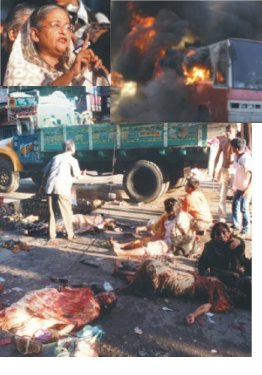
the leader of the opposition, Mrs. Sheik Hasina, was attacked with a grenade during a
political rally. She was fortunate to escape unharmed, but 18 people died either at the
scene or later from their injuries. Nice eh?
It's such a part of life here that we assume that after such an
incident the party in question, in this case the Awami League, will call a hartal to
show its displeasure as well as its strength to the powers that be. Their assumption of
course is that the attack was politically motivated and carried out by members of the
current ruling party, the Bangladesh National Party (BNP). Oh that this were the first
attack of a deadly nature this year, but an opposition MP was gunned down in May, again
during a political meeting in front of tens if not hundreds of witnesses. It goes almost
without saying that his killers have yet to be arrested, unsurprising when the
government dismissed it as "an internal struggle" of the opposition. More of
this later.
So what then happens during a hartal? Quite literally nothing. OK
there are hartals, and there are hartals, but this one came after an ugly incident so
was widespread and effective. For us VSO volunteers (for volunteer read
"foreigner" or " evil Islam-hating Westerner") we are basically put
under house arrest until things get back to normal. This is particularly the case for
volunteers living in cities like Dhaka or Chittagong, but even the provincial towns can
be a bit hairy if you turn the wrong corner and walk straight into an angry mob. For me
it's as if nothing has happened. My life on BRIF's campus, in the middle of nowhere, is
untouched by these political incidents so I continue to live and work as before. The
only difference comes when I want to go somewhere else or have a meeting with someone
from another organisation, as there are no buses, and chances are the other organisation
has shut down just in case it gets accused of not following the hartal. This week for
instance I had to cancel my Bangla lesson as there was no way I could safely get to
Parbatipur and back that particular hartal day. The real pisser though is that my fellow
volunteers "work from home" when there's a hartal (and we all know what that
really means don't we?) whereas I have to work as normal!
In some ways you could argue that a hartal, when it's done following
such a horrific incident as the one I've described, is quite a healthy reaction for a
people to have and an expression of how strongly they feel about politically motivated
(and dare I suggest officially sanctioned?) acts of terrorism. If only this was the
case. Instead of a hartal resulting from a ground swell of public opinion, they are
enforced through threats of reprisals from the political party asking for the hartal. At
present it is the Awami league, but the BNP did the same thing when they were in
opposition pre-2001. So, rather than face the wrath of local party activists, and to not
get beaten or have your shop burnt down, you stay at home and keep your head down. In
the end, what determines whether you follow the call for strike has nothing to do with
your own feelings about the issue allegedly being focussed upon, but is more an
indication of how you evaluate the risks of not following.
I recently read an interesting sociological paper analysing the power
structures at work in North-West Bangladesh. If I oversimplify the framework it put
forward, it comes down to a good and generous Muslim man (donations to the mosque etc.)
gaining the support of local people who then rally to his call when seeking political
office. In return, as his supporters well know beforehand, he will use his newly found
position of power to obtain government funds etc. to finance improvements that will
directly benefit his base. The monies obtained are fed into the villages that supported
him the most, as well as individuals in the form of contracts etc. for development and
infrastructure projects. Hence, the supporters are rewarded for their good work but
other local people, whether they're active opposition workers or not, are penalised for
not doing enough for the cause. I personally have met businessmen who used to be very
successful but now struggle as they are/were supporters of the now opposition
party.
This feeling of them and us is further compounded in Bangladesh by 2
other issues. The first is the Independence war of 1971, where there were those that
supported Pakistan (very Muslim usually) and those that were for independence. The BNP
is currently in power using an alliance with a fairly extreme islamic party and is seen
as being the party of the pro-Pakistan movement. The other issue concerns the 2 main
political leaders themselves. Both are women, and both entered politics due to the
assassination of the male member of the family who was in power when killed (her husband
for Khaleda Zia, the current Prime Minister, and her father for Sheik Hasina). It will
doubtless come as no surprise to learn that both women blame the other's camp for the
murder of their father/husband and so are more concerned with defeating their arch enemy
than serving the people of Bangladesh. As 2 hateful old women battle it out against each
other, so grenade attacks and shootings almost become acceptable forms of political
expression.
I find all of this a tad depressioning frankly, and along with the
way women are treated it is one of the things I hate most about how this country works,
or rather doesn't work. By the way, I recently heard that those boffins at the IMF and
World Bank have worked out that the few African countries that have improved their lot
in the last few decades don't owe their success to free-market economic policies
afterall - it all came down to having good governance. Well well well... Where I start
to worry is when I hear about the number of people that are arrested in the UK under
anti-terrorism legislation, are held for months or even longer, before being released
without charge. I don't have any statistics but I believe thatt the proportion of those
arrested that are charged, let alone convicted of a crime, is painfully low. Isn't that
also an example of the State attacking its enemies without any supervision or control? I
suppose we don't really need to worry. Afterall, such legislation is there to protect
"us" from "them", and we're clearly one of "us" aren't we?
I don't really find that terribly reassuring, if only because I'm not the one
controlling what defines "them" and "us", and I don't really trust
those people that are right now.