This is the full entry for week
52
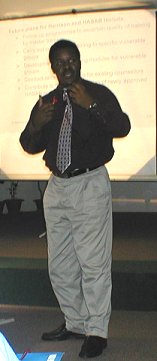
This week saw the launch of VSO Bangladesh's Country Strategic Plan (photo is Harrison presenting HIV/AIDS volunteer part),
a document 2 years in the making that sets out what it's trying to do and how. I could be cruel and say the highlight of the
event was the lunch (which was pretty good) but actually it went quite well and seemed to raise a far amount of interest in
partner organisations. So what are the strategic focus areas of VSO Bangladesh then? They are Participation and Good Governance,
HIV/AIDS and Indigenous peoples. My placement officially falls under the Governance strategy but between you and I we don't
really do much in that area. It is however a very noble and much needed cause, given the poor level of service provision and
rampant corruption.
As you may or may not know, and according to Transparency International, Bangladesh is the most corrupt country in the world.
It has even held this title for 3 consecutive years, pipping Nigeria to the top, which is in itself no mean feat. The only
examples I've seen of it personally have been rickshaw pullers who slip a few taka to policemen in Dhaka to go down roads
they're banned from at certain times of the day. The fact that the corruption exists at such a low and basic level is for
me an indication of the extent of the problem.
As Habib and I were travelling down to Dhaka in a bus on Tuesday, we got into a conversation about the administration and
corruption, as we quite often do. He was telling me about some officials he knows who are straight and resist the general
culture of corruption that affects all government departments and levels. To illustrate his point he told me about what happens
in schools, the very place you would have thought that corruption could start to be defeated through better education and
awareness of corruption's negative effects. It goes something like this:
Anyone can set up a school - all they need is a Masters degree, and this can be in any subject. To obtain permission to found
a school the person (who is basically the future Principal), must get approval from the local government. This of course involves
paying a bribe of around 100,000 to 200,000 taka. Why found a school if you have to pay a big bribe to start with? How can
the Principal get his money back?
First of all, all the salaries for the teachers etc. are paid by the government hence representing a solid and steady source
of income. As the Principal, he can give the contracts for building work etc. to whoever he wants, hence obtaining business
either for his own concerns or bribes from other companies wishing to do the work themselves. Next you have to find and recruit
teachers. The good ones can obviously find work easily anywhere they fancy. The bad ones, especially the poor recent graduates,
actually have to pay to get a job i.e. bribe the principal. Why pay to get a job? Because it's an easy job and very steady
income.
Lastly of course come the students. They all want to succeed and get good marks, so obviously they pay the teachers to get
access to the exam papers in advance. I read once of a group of students complaining about this sort of behaviour, which you
have to say from our perspective is a perfectly normal reaction. Cheating at exams is of course a very bad thing. So what
did these irate students propose as a solution to this appalling situation? Well, they thought that, seeing as not all of
the students could afford to buy the exam papers they should be given out to everyone for free. Brilliant! Why stop the lucky
few from cheating when you can level the playing field by allowing everyone to cheat? This makes me think of drug taking in
sport, and the surely not too distant future when we just say "ahh fuck it, just take drugs and we'll stop testing". During
the Athens Olympics the President of the IOC, while commenting about the number of athletes that had already tested positive
during the games, said that "we can't all be angels". Call me old fashioned but those are hardly the words of a man standing
up for a zero-tolerance policy now are they?
In an interesting twist to the schools situation, the government introduced minimum educational standards a few years ago
that were designed to ensure that all students reached a certain level. All of a sudden certain schools realised that, while
their operations were quite profitable for the Principal and his pals, they weren't actually effective pedagogic institutions.
As a result, and in an attempt to raise the standard of the student body, Principals would go and bribe good students from
other schools to entice them to come to theirs. You can't fault the basic logic of the solution can you?
When you look at how schools work, especially for the students, it is not hard to see how corruption not only manages to continue
but even becomes part of a child's education about how life works. Tragic really. At my level, given the sorts of projects
and skills my NGO has, there isn't a great deal we can do apart from speak out against it and resist officials who would have
us pay bribes. Internally though, I'm keen to make our financial management as transparent as possible to make corruption
nigh on impossible. In that spirit I was delighted with a meeting I had with Plan International this week about receiving
some simple yet effective accounting and reporting software for free! We currently have a 100 per cent paper-based system
that consumes too much time and makes it almost impossible to do any useful analysis. If we can improve that with this software,
and get better information into the hands of those that need it, I'll be a very happy camper indeed. The fact that analysing
the package and discussing its implementation means spending more time in Dhaka, and hence with Sarah, is neither here nor
there of course.