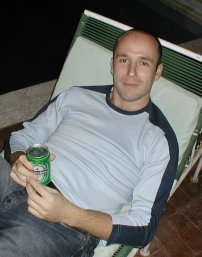
This is the full entry for week
9
As some of you kindly remembered, I celebrated my 32nd year this week.
Funnily enough, and as the photo on the left shows, it wasn't a whole lot different to
most other birthdays I've had i.e. I relaxed with friends eating food I like and drinking
as much beer as I like. The big difference though was that I could, at least during the
afternoon, do the above sitting next to a pool outside wearing shorts (I did go for a
swim but the water was a tad cold so didn't linger). I've never gone away anywhere warm
for my birthday so that was a bit of a novelty. To be honest, I don't think I'll ever
tire of sunny afternoons and 25-30 degrees so I may have to repeat the experience again
whenever possible.
While I've not really mentioned it, November was the Holy month of
Ramadan. Personally I've never really grasped what it's all about, so for my own personal
reference and anyone else who cares to know here are a few pointers:
The relgion of Islam is built on 5 pillars which all good Muslims are bound
to respect. These are 1) Belief in the Shehada, the statement in Arabic which says:
"There is no god but God and Muhammad is Prophet"; 2) Salah, prayer five times
a day. If this seems arduous to non-Muslims there is a tradition in Islam that Muhammad
actually beseeched God to reduce the number down to five from an original fifty times a
day. Prayer in Islam is praise of God - not asking or requesting things; 3) Zakat, the
paying of alms to the poor. This was traditionally calculated at 2.5 percent. Different
Muslim countries have different policies towards the zakat now that income tax has been
introduced in many of them. In Banglaesh I'm told this year the amount was set at 25 Taka
(roughly 25p) and is supposed to be equivalent to the price of a meal; 4) Hajj,
pilgrimage to Mecca. This is an obligation for all Muslims who can afford it once in a
lifetime. About two million Muslims go on hajj every year to Mecca in Saudi Arabia. The
trip carries enormous social prestige. Men who return from the Hajj are addressed by the
title "Pilgrim" in many Muslim countries. Many also paint a ship or a plane
(depending on how they got to Mecca) on the side of their houses to remind everyone of
the fact; and 5) Ramadan, the holy fasting month. In Ramadan, Muslims must not eat, drink
or make love from sunrise to sunset. In fact, they make up for it by feasting all night.
Ramadan is the most social time of the Islamic calendar and consumption of foodstuffs
rises so dramatically that there are often shortages
Ramadan is the ninth month of the Muslim calendar, a calendar based
on the moon which explains why Ramadan comes at a slightly later time each year. It is
declared to have started once the moon has been sighted by certain learned fellows, which
can mean you only have a day or so's notice as to the official start date
The Month of Ramadan is also when it is believed the Holy Quran
"was sent down from heaven, a guidance unto men, a declaration of direction, and a
means of Salvation". It is during this month that Muslims concentrate on their faith
by spending less time on the concerns of their everyday lives. It is a time of worship
and contemplation
During the Fast of Ramadan strict restraints are placed on the daily
lives of Muslims. They are not allowed to eat or drink during the daylight hours. Smoking
and sexual relations are also forbidden during fasting. At the end of the day the fast is
broken with prayer and a meal called the iftar. In the evening following the iftar it is
customary for Muslims to go out visiting family and friends. The fast is resumed the next
morning
According to the Holy Quran: "One may eat and drink at any time
during the night until you can plainly distinguish a white thread from a black thread by
the daylight: then keep the fast until night"
The good that is acquired through the fast can be destroyed by five
things: 1) The telling of a lie; 2) Slander; 3) Denouncing someone behind his back; 4) A
false oath; and 5) Greed or covetousness. These are considered offensive at all times,
but are most offensive during the Fast of Ramadan
During Ramadan, it is common for Muslims to go to the Masjid
(Mosque) and spend several hours praying and studying the Quran. In addition to the five
daily prayers, during Ramadan Muslims recite a special prayer called the Taraweeh prayer
(Night Prayer). The length of this prayer is usually 2-3 times as long as the daily
prayers. Some Muslims spend the entire night in prayer
On the evening of the 27th day of the month, Muslims celebrate the
Laylat-al-Qadr (the Night of Power). It is believed that on this night Muhammad first
received the revelation of the Holy Quran. And according to the Quran, this is when God
determines the course of the world for the following year
When the fast ends (the first day of the month of Shawwal) it is
celebrated for three days in a holiday called Id-al-Fitr (the Feast of Fast Breaking) or
just "Eid" as it's called here in Bangladesh. Gifts are exchanged, friends and family
gather to pray in congregation and for large meals. In some cities fairs are held to
celebrate the end of the Fast of Ramadan. Eid is equivalent in scale and celebration to
Christmas for example i.e. everyone buggers off back to their family / home town, all the
shops are shut and you eat vast quantities of food
Having presented the official version of things I'll now tell
you about a few of the daily effects of Ramadan I've seen or experienced:
Everything, even more so than usual, revolves around prayer time
i.e. when you get up, when you sleep and when you eat. There are people who go around the
houses near the mosques shouting to wake people up for breakfast before sunrise and the
first prayer a bit later
Generally speaking, offices close earlier as the staff are tired
from fasting all day. In Dhaka for example, it was common for people to finish at 3.30 -
4pm. Again I'd say it's much like the UK during the week before Christmas when people
spend their afternoons at Christmas parties, in the pub or just generally not achieving
a great deal
Restaurants and snack places place curtains in front of their
establishments to hide customers eating during the day
People spit more so as not to swallow their own saliva (i.e.
liquid / water) during day time
Several of us volunteers (including yours truly) went down with
anything from slight to full-on food poisoning due to food being left lying around all
day in the open air in preparation for the flood of people that break their fast all at
the same time at Iftar
The need to give to the poor, and hence to find some extra cash,
means that there is more crime through robberies and bag snatching during Ramadan.
People knock on your door asking for donations, prices for pretty much everything
increase noticeably, and the number of beggars seems to increase as they go looking for
the donations that are on offer during the month
So there you have it, the sum of my knowledge of Ramadan and it's
implications. As a closing comment, and if you look really closely, you can just about
make out my scar in the middle of my forehead on the photo above...